
The Real Cost of a Smart Board: Why Upfront Price Is Misleading
Sarfraz Akhter
12-Jan-2026


When schools evaluate smart boards, the first comparison usually starts with price. While upfront cost is easy to see, it rarely reflects the true cost of owning and using a smart board over its full lifecycle.
In classrooms, technology is expected to perform reliably every day, adapt to new teaching methods, and remain usable for years. When performance drops, the cost is not just financial — it affects teaching quality, adoption, and confidence.
This article explains what the real cost of a smart board looks like over time, why upfront price can be misleading, and how schools, buyers, and resellers can make decisions that hold up long after installation.
What is the Total Cost of Ownership (TCO) of a smart board?
Total Cost of Ownership refers to the full cost of a smart board over its usable life — including performance stability, teacher adoption, maintenance, downtime, upgrades, and replacement risk — not just the upfront purchase price.
Upfront Price vs Total Cost of Ownership
This concept builds on the performance fundamentals discussed in our guide on what makes a smart board perform better, where internal hardware design plays a critical role in long-term classroom reliability.
The purchase price of a smart board is only one part of its overall cost. What matters more is the Total Cost of Ownership (TCO) — the combined cost of buying, using, maintaining, and eventually replacing the board.
Over a typical five-to-seven-year lifecycle, costs are influenced by:
- Performance stability over time
- Teacher adoption and usage levels
- Maintenance and downtime
- Software update impact
- Replacement or upgrade cycles
Boards that appear affordable initially can become expensive if they fail to deliver consistent classroom performance.
The Hidden Costs Schools Don’t Always Calculate
The Iceberg Model of Smart Board Cost
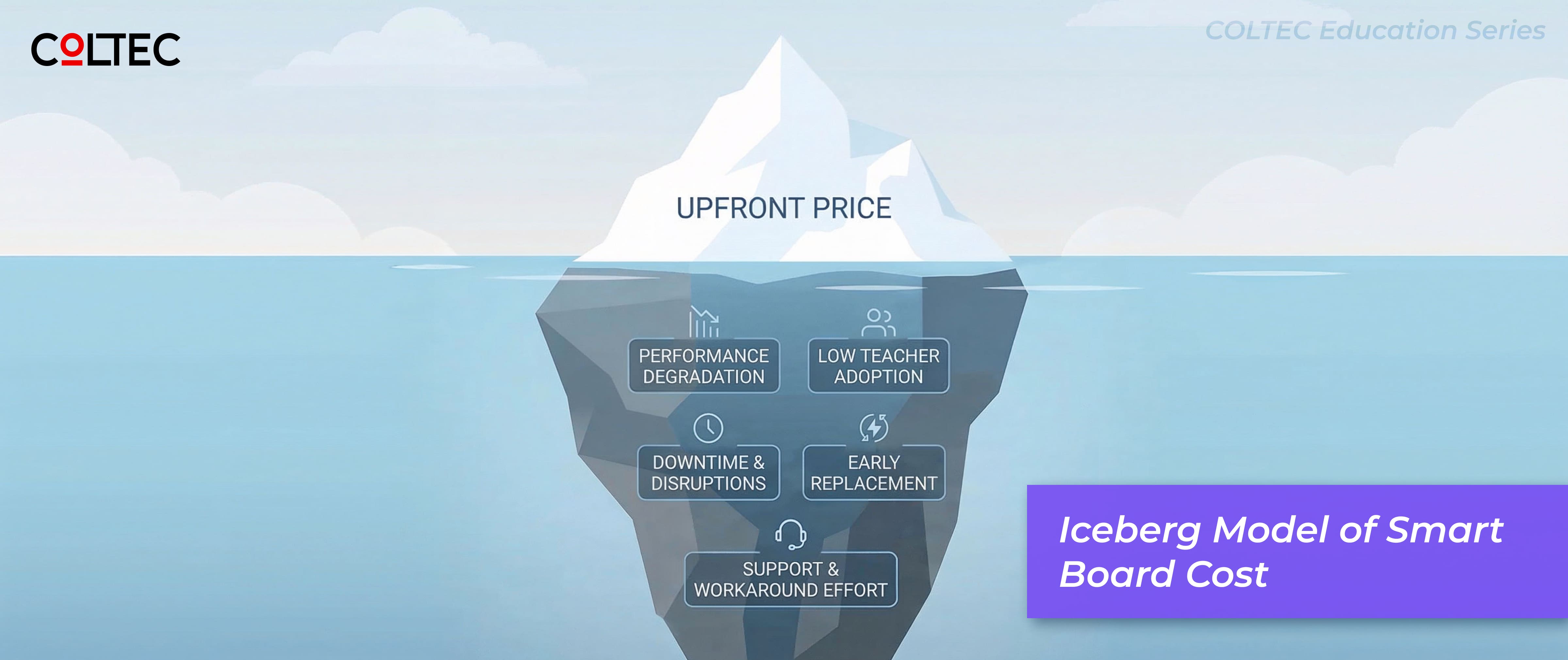
The price tag of a smart board is only the visible tip of the iceberg. Beneath the surface lie ongoing costs related to performance stability, usability, and longevity.
When these hidden layers are ignored, schools often underestimate the real investment required over time.
Many long-term costs remain invisible at the time of purchase. These include:
1. Under-utilisation Cost
When a smart board becomes slow or unreliable, teachers naturally reduce usage. Features that justified the purchase remain unused, turning the board into a basic display.
2. Lost Teaching Time
Lag, crashes, and restarts disrupt lessons. Over time, these interruptions accumulate into meaningful loss of instructional time.
3. Early Replacement Risk
Boards that cannot handle evolving software or teaching tools often need replacement sooner than expected — increasing capital expenditure.
4. Support and Workaround Cost
Frequent troubleshooting, manual workarounds, or reliance on external devices adds hidden operational burden.
Why Performance Stability Drives Value
The Stability Curve: How Cost Evolves Over Time
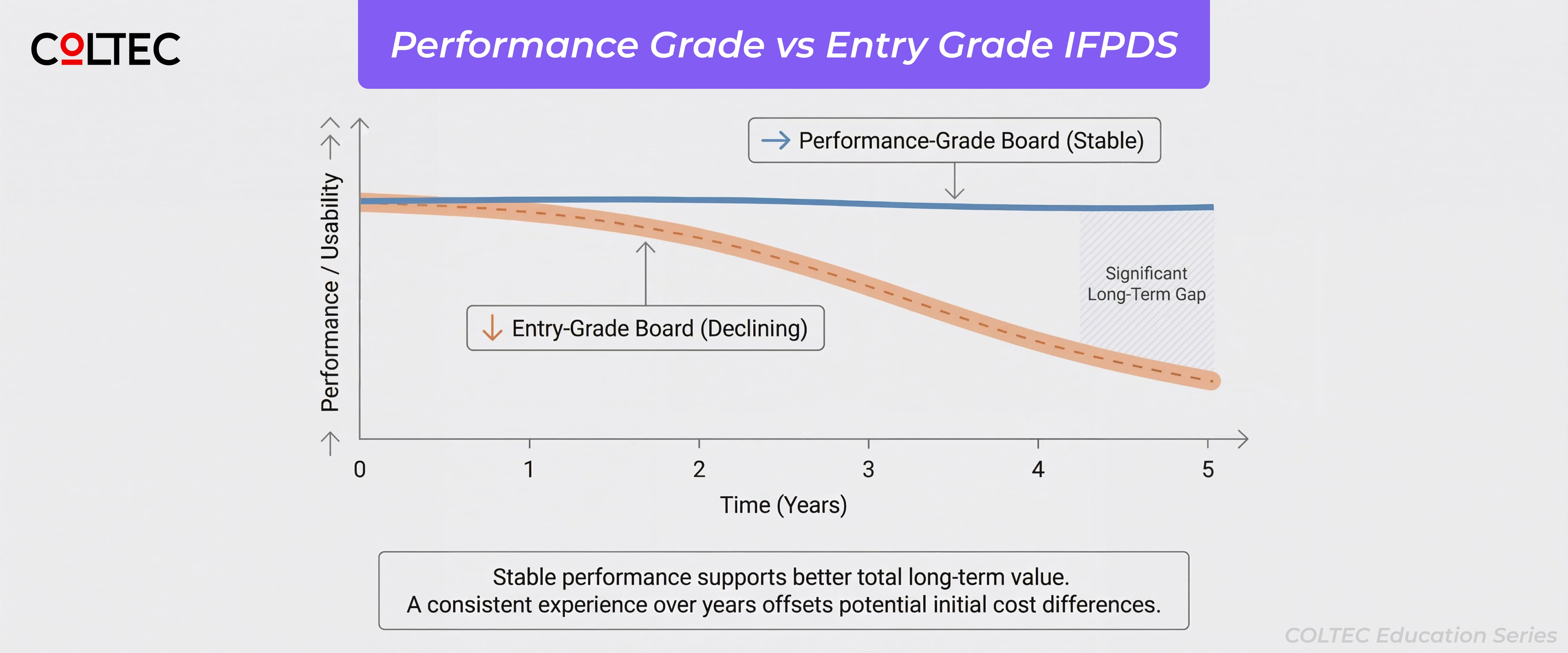
Smart boards follow a predictable performance curve. Boards built without sufficient performance headroom may work well initially, but degrade as usage and software demands increase. Performance-grade boards are designed to remain stable across years of continuous classroom use.
This stability directly determines whether a board delivers consistent value or becomes a recurring cost center.
Performance stability is one of the strongest predictors of long-term value. Smart boards designed with performance headroom are better equipped to handle:
- Continuous daily usage
- Multitasking in live classrooms
- Software updates over multiple years
- Introduction of advanced teaching tools
When performance remains consistent, schools extract full value from their investment throughout the product lifecycle.
Price-Led Decisions vs Value-Led Decisions
Price-led decisions focus on immediate savings. Value-led decisions focus on sustained outcomes.
Price-led decisions often result in:
- Short-term savings
- Long-term frustration
- Lower adoption
- Repeated investments
Value-led decisions prioritise:
- Reliability
- Teacher confidence
- Consistent classroom usage
- Predictable long-term costs
Understanding this distinction helps buyers align purchasing decisions with educational outcomes.
It also connects directly to why the same teaching software can feel inconsistent across different panels — a topic we explain in why the same smart board software feels different on different panels.
How Hardware Design Influences Long-Term Cost
The internal design of a smart board plays a critical role in determining its lifecycle cost. Boards built on entry-grade hardware may meet basic requirements initially but struggle as classroom demands grow.
Performance-grade hardware, on the other hand, supports:
- Stable performance over time
- Software evolution without degradation
- Reduced need for external add-ons
- Longer usable life
This directly lowers the real cost per year of use.
How COLTEC Looks at Cost Beyond Price
At COLTEC, cost is evaluated through the lens of classroom outcomes, not just purchase value.
Smart boards are engineered to deliver:
- Consistent performance throughout their lifecycle
- Higher teacher adoption
- Lower disruption and downtime
- Better long-term value for institutions
This approach ensures that investment decisions remain sound well beyond the first year of use.
This philosophy is reflected across our range of COLTEC Interactive Flat Panel Displays, which are engineered for sustained classroom performance rather than short-term specification matching.
A Practical Way to Evaluate Real Cost
Before finalising a smart board purchase, schools should ask:
- Will this board remain responsive after years of daily use?
- Can it support future teaching tools and updates?
- What is the realistic replacement timeline?
These questions shift the focus from upfront price to long-term value.
Conviction Check for Decision-Makers
Before finalising a purchase, decision-makers should pause and ask:
- Are we optimising for the lowest price or the lowest long-term risk?
- Will this board still perform reliably when teaching methods evolve?
- Are we buying a display — or a classroom system?
Clear answers to these questions separate cost-saving decisions from value-preserving investments.
Key Takeaway
The real cost of a smart board is not defined by its price tag. It is defined by how long it remains useful, reliable, and actively used in classrooms.
Choosing a smart board designed for long-term performance helps schools maximise value, minimise disruption, and protect their investment over time.
This article is part of COLTEC’s education series on smart classroom technology, created to help schools, buyers, and partners make informed, future-ready decisions.
Latest Blogs
Blog Categories
Leave a Comment
Comments
No comments yet. Be the first to comment!

