
Why Smart Boards Fail in Classrooms: The Underuse Problem and How to Fix It
Imran Ahmed
29-Sep-2025

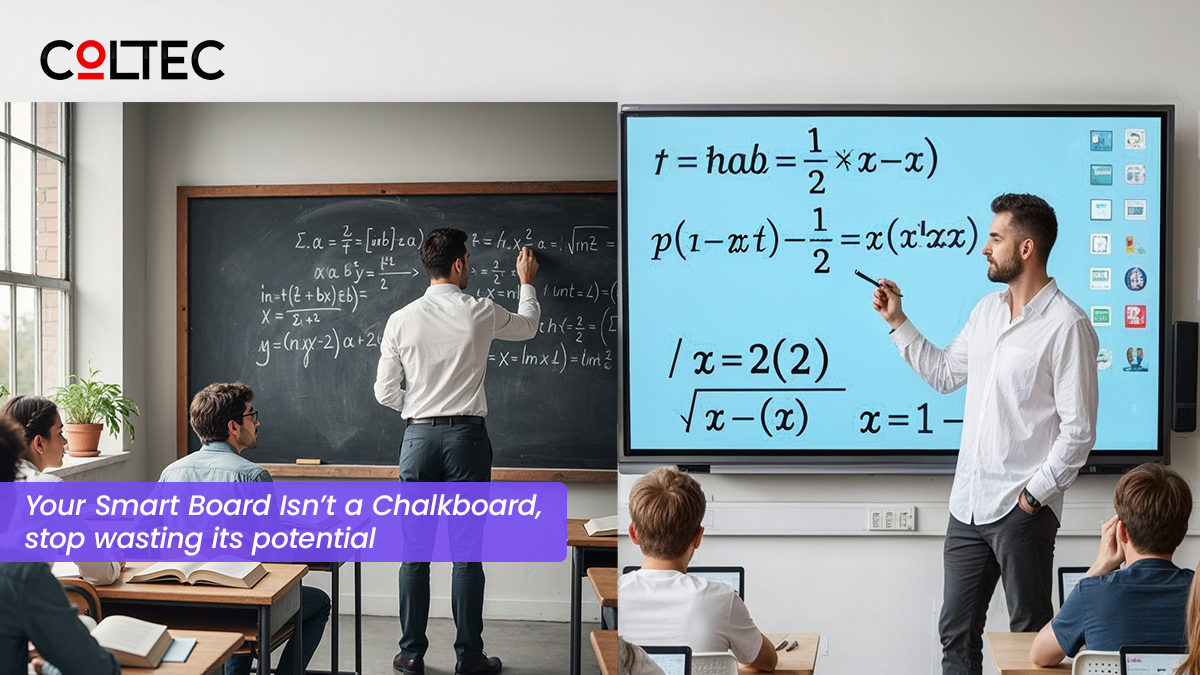
Across schools, smart boards (Interactive Flat Panel Displays – IFPDs) are replacing blackboards and whiteboards. They promise multimedia learning, interactive lessons, and engaging classrooms. Yet, the reality is that in most schools, teachers use less than 20% of the smart board’s potential. In many cases, it becomes just a digital blackboard—used only for writing with a single color. If that’s the only box being ticked, was the heavy investment really worth it?
This underuse not only diminishes ROI but also defeats the purpose of ICT integration as outlined in NEP 2020 and NCF 2023, which emphasize the meaningful use of technology to enhance teaching and learning.
The Gap Between Potential and Practice
Smart boards come with a host of smart classroom technology benefits and features:
- ✅ Digital colorful whiteboard tools
- ✅ Multimedia support (audio, video, images)
- ✅ Access to digital textbooks and e-content
- ✅ File management for easy lesson access
- ✅ Interactive 3D models for STEM subjects
- ✅ Curriculum-aligned digital content
- ✅ Collaboration and annotation tools
- ✅ Real-time assessments and quizzes
- ✅ Screen sharing and content sharing from devices
- ✅ Cloud storage integration
But in many classrooms, only one box is ticked: writing on the board. That means schools are spending lakhs to replicate what a blackboard already does.
Why This Happens
- Lack of built-in digital syllabus content: Teachers don’t have easy, ready-to-use resources aligned with NCERT, CBSE, or State boards.
- Complexity: Without training and simple workflows, teachers avoid multimedia features.
- No usage analytics: Management doesn’t know how much or how little boards are being used.
- Cultural resistance: Teachers and schools often default back to traditional methods.
The Real ROI of Smart Boards
For ICT investments to deliver value:
- Teachers must use multimedia and interactive content daily.
- Students must benefit from better understanding through visuals and simulations.
- Management must see usage reports that prove adoption and progress.
If smart boards are only used for writing, the ROI is almost zero. But when teachers use even 5–6 out of the 10 key features, the classroom impact—and return on investment—grows exponentially.
How to Solve the Underuse Problem
1. Provide inbuilt, syllabus-aligned content
Teachers should have instant access to curriculum-based digital resources (videos, 3D models, assessments) so they don’t waste time searching.
2. Interactive & student-focused content
Digital resources should make learning easier for students—bringing abstract concepts to life.
3. Usage analytics for accountability
Teachers and management should be able to track usage and identify training needs.
4. Build a culture of ICT in classrooms
Schools must encourage teachers to experiment with multimedia, file management, assessments, and collaboration tools. ICT should be part of everyday teaching, not just a showcase.

How COLTEC + QEEB Bridge the Gap
COLTEC Smart Boards, powered by the QEEB Classroom Platform, are built to solve this exact problem:
- 🎯 High-quality, reliable hardware designed for classroom durability.
- 🎯 International-grade syllabus-aligned content mapped to NCERT, CBSE, ICSE, and State Boards.
- 🎯 Interactive 3D model library (3IC) for immersive STEM learning.
- 🎯 AI-powered teacher tools for instant lesson plans, quizzes, and voice control.
- 🎯 Integrated ecosystem with Courseware, Assessments, File Management, LMS, and Collaboration in one platform.
By combining reliable hardware with a teacher-first software ecosystem, COLTEC ensures schools actually use technology as intended—maximizing ROI and aligning with NEP 2020 & NCF 2023 ICT goals.
👉 Want to see the product in detail? Explore the COLTEC Smart Interactive Flat Panel
You can also learn more about the QEEB Platform and our vision at COLTEC Global
Conclusion
The smart classroom paradox is clear: technology is purchased, but barely used. The way forward isn’t just better boards—it’s better ecosystems. With the right content, training, analytics, and culture, smart boards can finally go beyond being expensive blackboards to becoming catalysts of engaged, 21st-century learning.
💬 We’d love to hear from you! Share your thoughts in the comments below—how are smart boards being used in your classrooms? Do you face similar challenges?
🔔 If you found this article useful, please share it with your network and help start a conversation on meaningful use of ICT in education.

Latest Blogs
Blog Categories
Leave a Comment
Comments
No comments yet. Be the first to comment!

